The Hormuz crisis returns to square one... Attacks on ships are draining the Gulf's energy and trade
The Hormuz crisis returns to square one... Attacks on ships are draining the Gulf's energy and trade
Economic circles are examining the logistical repercussions and long-term financial implications of escalating security risks in the Arabian Gulf region. The threats have shifted from simply increasing "war risk premiums" to Tehran targeting commercial vessels and tankers in the vicinity of the Strait of Hormuz. This now directly threatens the region's energy and oil resources, free zones, and ports. Many ships have begun to cancel their voyages through the Strait of Hormuz, and operational data from insurance and shipping companies indicates unprecedented surges in shipping costs. This has highlighted the possibility of the Gulf Cooperation Council (GCC) countries expediting the construction of an integrated land bridge linking the ports of Oman and the UAE to Saudi Arabia, thus permanently bypassing the waterways.
US President Donald Trump declared on Wednesday that the truce with Iran had ended, reigniting concerns about waterways, energy markets, and trade, particularly in the Gulf. Three ships were struck by Tehran the day before yesterday, prompting the US to retaliate with attacks inside Iran. This was followed by the Iranian Revolutionary Guard's announcement yesterday that it had targeted US sites in Bahrain and Kuwait, effectively returning the tensions in the Strait of Hormuz to square one. In this context, the Kuwaiti Ministry of Electricity announced in a statement yesterday that several power transmission lines were damaged by shrapnel from attacks, but that this did not affect the continuity of the ministry's services.
Amid these developments, Gulf states are exploring alternative routes for oil exports. Sources confirmed that Saudi Arabia is planning to increase the capacity of its crude oil pipeline to the Kingdom's western coast on the Red Sea by two million barrels per day. This would enable Saudi Arabia, and possibly its neighbors, to transport larger quantities of oil without having to cross the Strait of Hormuz, according to Reuters the day before yesterday.
With the developments of the crisis, war risk insurance premiums for crossing the Gulf were reassessed to reach about 4% of the value of the ship, reflecting enormous pressure on the cost of supply chains, especially since alternative insurance coverages are recording astronomical levels, as the price of “protection and compensation replacement coverage” reached about $30,000 per week for protection that previously cost about $25,000 per year. This increase undermines the investment attractiveness of inland Gulf ports and imposes stifling operational restrictions on the movement of ships passing through the Strait of Hormuz, according to a report published by The OpsCon platform, which specializes in security analysis and maritime logistics operations, on June 20.
Increased risks after ships were hit
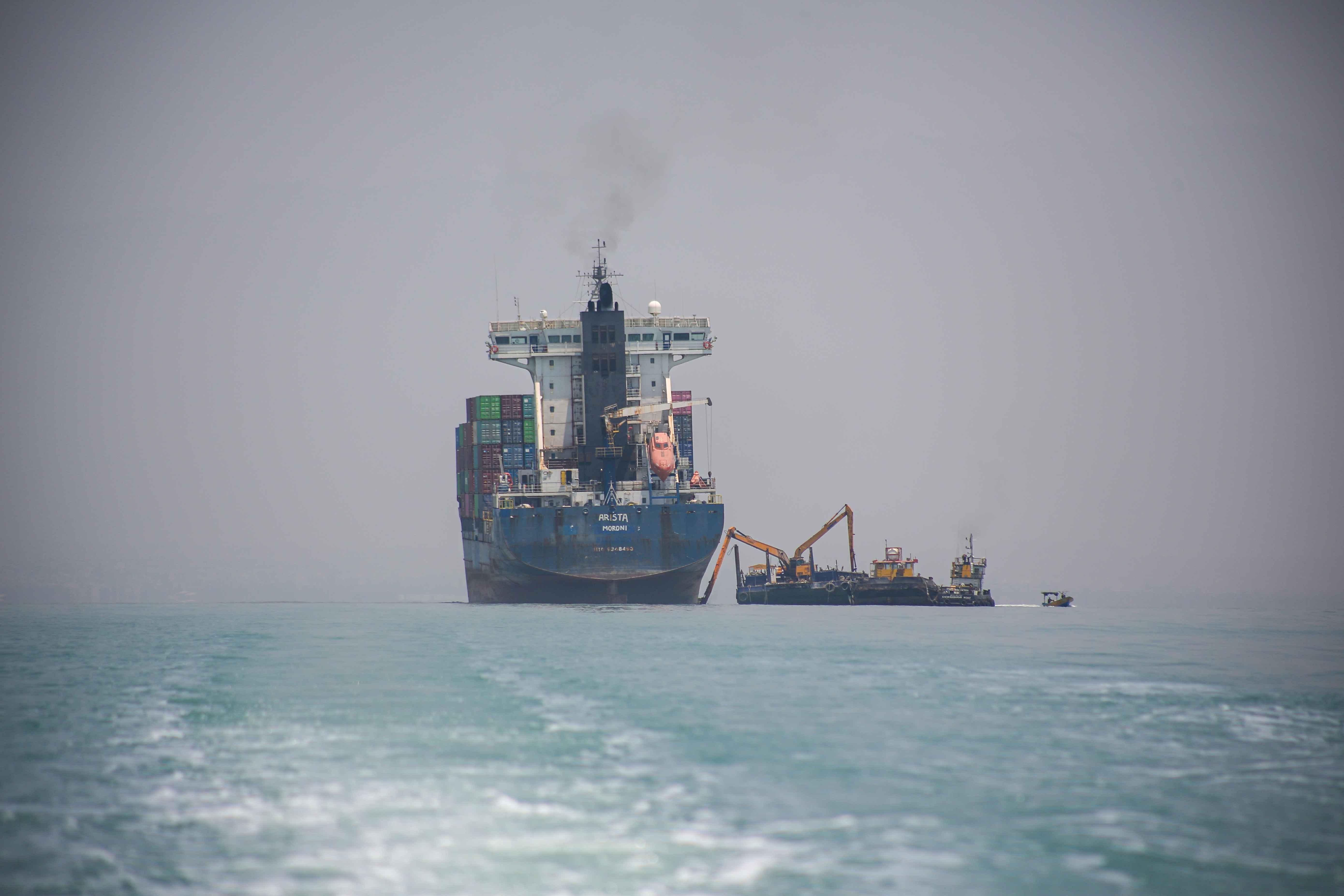
These concerns intensified in the past two days after a Qatari liquefied natural gas tanker and a Saudi-flagged oil tanker were damaged near the Strait of Hormuz on Wednesday. This prompted maritime security authorities to raise the risk level for transiting vessels to "severe." Ship tracking data showed that at least four oil and gas tankers turned back from completing their voyages through the strait, indicating that shipping companies are now preferring to postpone transits or reroute vessels rather than risk increased security. This has also disrupted some energy tanker traffic originating from Qatar and the UAE, with dozens of tankers remaining in limbo or outside their usual tracking routes, according to data compiled by Reuters from ship tracking companies and shipping sources on Wednesday. The Secretary-General of the International Maritime Organization, Arsenio Dominguez, condemned the attacks on ships in the Strait of Hormuz on Wednesday and called for maximum restraint in a statement.
Despite diplomatic efforts to calm the situation, international shipping experts believe that these developments confirm the continued structural risks in the Strait, and that any temporary improvement in traffic does not reflect an actual restoration of maritime security, as insurance and shipping companies will continue to price risks at high levels, which deprives the Gulf free zones of the advantage of stable shipping costs and threatens to divert some of the trade routes to alternative routes and outlets outside the areas of tension, according to an assessment published by Lloyd's List, a platform specializing in maritime transport and global shipping affairs, on June 26.
Regarding domestic supply chains, the crisis of empty container accumulation and shortages stands out as a major threat to the ability of small and medium-sized enterprises (SMEs) to remain financially viable in the face of current bottlenecks. The crisis is exacerbated by major shipping lines imposing strict restrictions on the delivery locations of imported containers. This action forces small importers to bear exorbitant cross-border land transport costs or pay high unloading fees at local ports, such as Jebel Ali Port in the UAE, at a rate of $600 per 20-foot container and $600 per 40-foot container. This drains the working capital of these companies and puts their continuity at real risk, according to an operational update published by Maersk, a global logistics and shipping platform, on June 26.
To permanently overcome these maritime crises, the GCC countries are seeking to accelerate the establishment of an "integrated land bridge" linking the ports of the Sultanate of Oman and the United Arab Emirates with the Kingdom of Saudi Arabia to completely avoid the water straits. However, the current complications reveal the limitations of relying solely on trucks, especially after global shipping lines announced the temporary suspension of land bookings for goods destined for the UAE and Qatar via Jeddah port and Omani ports.
Uncertainty after the return of unrest
In this context, political economy expert Ziyad Zuwaneh tells Al-Araby Al-Jadeed that the war on Iran has created a complex state of instability affecting the entire world. The Gulf states have been at the heart of these repercussions to varying degrees, especially after the signing of the Iranian-American and Lebanese-Israeli agreements. This has placed the region in a sensitive transitional phase characterized by uncertainty, particularly after the resumption of attacks on ships.
Zuwaneh adds that managing the current phase is characterized by several key elements, most notably the continuation of unrest, the ongoing stalled negotiations, intermittent military clashes, and contradictory threats and statements. This makes the geopolitical, geoeconomic, and military risks and their costs a stark reality for the entire world.
Real-world examples of these risks are evident in the Gulf Cooperation Council (GCC) countries, which, according to Zuwaneh, necessitates the adoption of multiple, simultaneous strategies based on flexibility, adaptability, diversification of trade routes, containment of energy shocks, overall resilience, and the formation of diverse alliances. This forces markets, investors, and companies, particularly in the global transport, insurance, and shipping sectors, to exercise extreme caution in their dealings.
Zuwaneh emphasizes that the volatility of oil, gas, gold, and production input prices serves as a vivid illustration of this transitional phase. Added to this in the GCC are the challenges of restoring the pre-war economic, commercial, financial, political, and security model, and the feasibility of achieving this given the reduced need for expatriate labor. This leaves global shipping, insurance, and transport companies as mere models of a shattered mosaic being reassembled and reshaped, leaving the questions of how, when, and who ultimately benefits from this process open-ended and without definitive answers.
He points out that major countries such as the United Kingdom, France, Germany and the United States are experiencing a rise in their public debt, a change in their governments, popular discontent and a disappearance of confidence in the American ally due to its internal conflicts, in addition to the fragility of the American stock markets and the ambiguity of interest rates, which makes betting on global stability a fictitious bet at the present time, according to Zuwaneh’s vision.
Tax on maritime activities
In this context, Recep Yorulmaz, president of the International Association for Economic Policy Research, tells Al-Araby Al-Jadeed that the conflict in the Gulf has turned into something resembling an “economic tax” imposed on maritime and energy activities, as war risk insurance fees and route rerouting fees, which were previously incidental expenses, have become permanent and continuous components of shipping and logistics costs for ships frequenting Gulf ports.
These high costs negatively impact free zones like Jebel Ali, which have long competed based on low-cost and predictable logistics. As Yorulmaz explains, these fees increase the apparent cost of imports and exports and diminish the intangible advantages such as speed, reliability, and trust that attract manufacturers and distribution centers.
Higher premiums and longer transit times increase the final costs for tenants in free zones. Large, integrated companies can partially absorb or hedge these additional expenses, while small and medium-sized enterprises (SMEs) cannot. According to Yorulmaz, this leads free zones to retain larger, capital-intensive tenants with greater financial capacity, while smaller companies face squeezed profit margins and the loss of contracts or incentives to relocate to less risky transit hubs or those closer to their production sites.
One of the problems associated with this, according to Yorulmaz, is the shortage and misallocation of empty containers. Conflicts and route rerouting alter trade flows and create persistent mismatches between the locations of full and empty containers. When empty containers accumulate in ports where exporters don't need them, leasing and purchasing costs rise, and the risks of detention and demurrage charges increase. This leaves small businesses that rely on just-in-time imports, such as spare parts suppliers and food manufacturers, with longer cash flow cycles and tied-up capital in delayed shipments. This increases the risk of insolvency for these companies and reduces employment and regional export activity.
Policymakers in the GCC countries can take steps to reduce exposure to bottlenecks and alleviate financial pressure on SMEs through measures that combine infrastructure investment with regulatory and market interventions. A key priority, Yorulmaz suggests, is prioritizing and financing commercially viable back-end connectivity projects (such as the Duqm/Salalah corridor to Saudi Arabia and phased upgrades around Jebel Ali) through mixed public-private partnerships.
The president of the International Association calls for accelerating customs and regulatory integration through a unified regional transit window system, harmonized transit documentation, and uniform rules for vehicles and loads to make land and rail corridors effective alternatives to sea corridors, in addition to using port resources and sovereign wealth funds to create temporary container parks and provide lease guarantees targeting small and medium enterprises, including short-term support for repositioning empty containers and setting a cap on demurrage charges.
Yayın Tarihi:
09 Temmuz 2026